






















For foreign investors seeking a direct path to U.S. permanent residency, few options are as compelling as the Immigrant Investor Program. Whether you are an entrepreneur looking to expand your portfolio or a family seeking new opportunities in the United States, understanding the intricacies of this program is the first step toward achieving your goals.
The eb5 visa offers a unique route to a Green Card, distinct from employer-sponsored or family-based immigration. It empowers investors to obtain residency by contributing capital to U.S. commercial enterprises that stimulate the economy. However, navigating the requirements—from minimum investment thresholds to strict job creation mandates—can be complex. This guide breaks down everything you need to know about the process, requirements, and benefits, ensuring you have the knowledge to make informed decisions about your future in America.
What is the EB5 Visa?
The eb5 visa is a U.S. immigrant visa created by Congress in 1990 under the Immigration Act. Its primary purpose is to stimulate the U.S. economy through job creation and capital investment by foreign investors. Administered by the United States Citizenship and Immigration Services (USCIS), the program allows eligible foreign nationals to obtain lawful permanent residence—commonly known as a Green Card—by investing a significant amount of capital in a new commercial enterprise in the United States.
Unlike other employment-based visas that often require a specific job offer or extraordinary ability, the Immigrant Investor Program is based solely on the economic impact of the applicant’s investment. To qualify, an investor must not only meet financial thresholds but also demonstrate that their capital was legally acquired. The program has evolved significantly over the years, particularly with the introduction of the Regional Center Program in 1992, which allows for a more flexible approach to meeting job creation requirements. Today, it remains one of the most popular pathways for high-net-worth individuals to secure a future in the U.S. for themselves and their immediate families.
How Does the EB5 Visa Work?
Securing this visa requires navigating specific financial and operational mandates designed to ensure the investment benefits the U.S. economy. The core of the program revolves around two main pillars: the investment amount and the creation of jobs.
Investment Requirements and TEAs
The minimum capital required depends heavily on where the business is located. As of 2026, the standard minimum investment amount is $1,050,000. However, the program incentivizes investment in specific locations known as Targeted Employment Areas (TEAs). If you invest in a TEA—defined as either a rural area or an area with high unemployment (at least 150% of the national average)—the minimum investment threshold drops to $800,000. This lower threshold makes TEAs a highly attractive option for many applicants. Regardless of the amount, all funds must be “at risk,” meaning there is no guarantee of return, and the investor must prove the lawful source of these funds through rigorous documentation.
Job Creation Mandates
Capital investment alone is not enough; the money must tangibly benefit U.S. workers. The program mandates that the investment creates or preserves at least 10 full-time jobs for qualifying U.S. workers within two years of the investor’s admission to the United States as a Conditional Permanent Resident.
Regional Center vs. Direct Investment
Investors can choose between two distinct pathways: Direct Investment or the Regional Center Program.
- Direct Investment: You invest directly into a business you own or manage. You must prove that your specific capital directly created the required 10 jobs on the company’s payroll.
- Regional Center: You invest in a USCIS-designated economic unit, often a large real estate or infrastructure project. The key advantage here is the ability to count “indirect” and “induced” jobs toward the requirement—jobs created in the wider community due to the project’s economic activity. This makes meeting the job creation criteria significantly easier, explaining why the vast majority of applicants choose this route.
The EB5 Visa Process
The journey to permanent residency is a multi-step process that requires patience and precision. It involves filing specific petitions with USCIS and undergoing consular processing or adjustment of status.
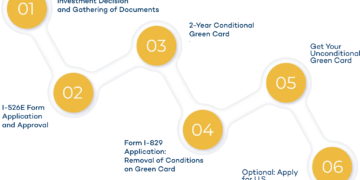
Step 1: Filing Form I-526
The process begins with filing Form I-526 (Immigrant Petition by Alien Investor) or Form I-526E. This petition proves you have invested—or are in the process of investing—the required capital. You must submit extensive documentation, including evidence of the lawful source of funds and a comprehensive business plan. Because of the strict regulatory scrutiny and the high stakes of the application, many investors find that this is the primary stage why a business requires legal services to ensure all filings are compliant with USCIS standards.
Step 2: Conditional Green Card and Status Adjustment
Once the I-526 petition is approved, the next step depends on your current location.
- Consular Processing: If you are outside the U.S., you will file Form DS-260 and attend an interview at a U.S. embassy or consulate in your home country.
- Adjustment of Status: If you are already in the U.S. on a valid non-immigrant visa, you can file Form I-485 to adjust your status to a permanent resident. A major benefit of the Reform and Integrity Act is the ability to file this concurrently with your I-526 petition if a visa number is immediately available.
Upon approval, you and your eligible family members are granted a Conditional Green Card valid for two years. This status grants the same rights as permanent residency but is “conditional” on your investment being sustained and jobs being created.
Step 3: Removing Conditions with Form I-829
The final hurdle occurs near the end of the two-year conditional period. Within the 90-day window before your Conditional Green Card expires, you must file Form I-829 (Petition by Investor to Remove Conditions on Permanent Resident Status). This petition proves that you maintained your investment and met the job creation requirements. Once approved, the conditions are removed, and you receive a standard 10-year permanent resident card, securing your indefinite future in the United States.
Benefits of the EB5 Visa
The eb5 visa offers distinct advantages over other immigration pathways, providing freedom and flexibility to investors and their families. One of the most significant benefits is the direct path to U.S. permanent residency without the need for an employer sponsor. Unlike H-1B or L-1 visas, you are not tied to a specific job or company. You have the liberty to work, study, or retire anywhere in the United States.
Furthermore, the program is inclusive of your immediate family. Your spouse and unmarried children under the age of 21 are eligible to receive Green Cards alongside you. This opens doors for your children to attend U.S. schools and universities at resident tuition rates in many states, and eventually seek employment without requiring visa sponsorship.
Another key advantage is the potential for a return on investment. While the primary goal is immigration, your capital is invested in a commercial enterprise. If the project is successful, you may receive a return on your investment or even a profit, in addition to securing residency. Finally, after holding a Green Card for five years, you and your family may be eligible to apply for U.S. citizenship, granting you full participation in American civic life.
Challenges and Considerations
While the rewards are high, the path is not without its hurdles. One of the primary challenges is visa retrogression. Each country has a cap on the number of visas issued annually. High-demand countries like China and India often face significant backlogs, meaning investors may have to wait years for a visa number to become available even after their initial petition is approved.
Financial risk is another inherent consideration. By law, the investment capital must be “at risk,” meaning there is no guarantee you will get your money back. Project failure can jeopardize not only your capital but also your immigration status if the required jobs are not created. Due diligence is critical when selecting a project, particularly Regional Center projects where you have limited managerial control.
Documentation is also a strict hurdle. USCIS scrutiny on the source of funds is intense. Investors must provide a clear, unbroken paper trail proving their funds were obtained lawfully. Incomplete or inconsistent documentation frequently leads to Requests for Evidence (RFEs), which can significantly delay the process. Finally, processing times are notoriously unpredictable and often lengthy, requiring investors to have patience and flexible long-term plans.
Frequently Asked Questions (FAQs)
Q: What is the minimum investment required?
A: The standard minimum investment is $1,050,000. However, if you invest in a Targeted Employment Area (TEA)—a rural area or an area with high unemployment—the minimum is reduced to $800,000.
Q: Can my family members come with me?
A: Yes. Your spouse and unmarried children under the age of 21 are eligible to obtain Green Cards as derivative beneficiaries of your application.
Q: What is the difference between Regional Center and Direct Investment?
A: Direct investment requires you to create 10 full-time jobs directly on your payroll. Regional Center investment allows you to count indirect and induced jobs created by the project’s economic impact, making it easier to meet job creation requirements.
Q: What happens if the project fails?
A: If the commercial enterprise fails and does not create the required 10 jobs, your petition to remove conditions (Form I-829) may be denied, resulting in the loss of your residency status. Thorough due diligence on the project’s viability is essential.
Q: Is premium processing available?
A: Premium processing is generally not available for the initial Form I-526 petition. However, rural TEA projects are eligible for priority processing, which can significantly shorten adjudication times.
Q: How long does the process take?
A: Timelines vary widely based on your country of origin and the complexity of your case. It typically takes several years from filing the initial petition to receiving a permanent Green Card.
Q: Do I need to live near my investment?
A: If you invest through a Regional Center, you are not required to live near the project. You can live anywhere in the United States. Direct investors typically need to be closer to manage the business day-to-day.
Conclusion
The Immigrant Investor Program remains a powerful tool for those with the means to invest in the American dream. It offers a clear, albeit complex, pathway to permanent residency, granting freedom and opportunity to investors and their families. While the financial commitment and documentation requirements are substantial, the long-term benefits of living, working, and studying in the U.S. are often worth the effort.
Success in this arena requires careful planning. From selecting the right project to navigating the intricacies of Form I-526 and source of funds documentation, professional guidance is indispensable. By consulting with experienced immigration attorneys and financial advisors, you can mitigate risks and navigate the process with confidence, securing a stable future in the United States.